FYI: If you buy something through a link on this site I may earn a commission - at NO extra cost to you.
Pain Medication for Dogs
Finding pain medication for dogs which can provide quick, safe relief is important when Fido or Fifi is in pain or distress.
When your question is 'What can I give my dog for pain?' the first person to ask is your veterinarian.
ALWAYS check with a veterinary professional before you give Fido anything that hasn't been prescribed for him, or that is a 'human' drug.
There are several pain relievers that have been specifically designed for dogs, and when given according to the directions and recommendations these dog-approved medications are usually both safe, and effective (although side-effects, both minor and major, are possible).
You may, in some situations, be able to give your dog certain over-the-counter products... but there are many variables and it's still important to check with your veterinarian first.
Dogs are very good at disguising the fact that they're in pain or feeling discomfort. They don't act the way humans do. It's important for us to learn how to recognize the signs of pain in dogs, so that we can get them the right help, at the right time.
Some veterinarians undertake extra training and study with the International Academy of Veterinary Pain Management in order to become a Certified Veterinary Pain Practitioner (CVPP) and specialize in pain management for pets.
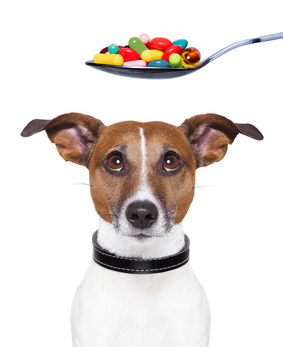
It's vitally important to get the dosage right when giving pain killers to your dog (and of course the same applies to any type of medication). Veterinarians often also recommending giving the
minimum effective dose for the shortest possible duration.
Let's take a closer look at the options for dog pain relief medications. Click on any link below to jump directly to a specific section, or simply scroll down to see full article.
- Over-the-counter pain medication for dogs
- Prescription pain medication for dogs
- Medications Poisonous to dogs
- Safety tips & information
OTC Pain Medication For Dogs
This is where pet owners sometimes turn to the products that are already in their homes. While it is possible that there is a pain medication in your home which is suitable, and safe, to give to your dog, but there are many more which are not.
Some medicines should never be given to dogs (or cats) and going ahead and dosing your dog without checking with a veterinarian first could lead to tragedy.
Certain medications can be contra-indicated if your pet has specific health conditions (including pregnancy) or is taking other medicines. Most are not suitable for puppies.
Avoid 'PM' Formulas
'PM' formulas (such as Tylenol PM) contain the active ingredient Diphenydramine HCI which has a mild sedative effect.
It's also found in products like Benadryl which make us sleepy.
Although Diphenydramine isn't approved for use in dogs, veterinarian's are often comfortable prescribing it (and SOME medications which contain it).
Most pain medications which have a 'PM' formula are not suitable for pets, NEVER use them for your dog without first consulting your veterinarian.
Can I Give My Dog Aspirin?
Aspirin can reduce swelling and inflammation, as well as lower a fever.
Aspirin has not been formally approved for veterinary use and opinion varies among veterinary professionals as to whether or not it should be given to dogs.
There are many other pain killers which are more effective, and safer, than aspirin.
Some veterinarians do approve it's use to treat pain in certain conditions, and in certain dogs and it should only be given to dogs under veterinary supervision. Aspirin is most often as a short-term treatment for minor aches and pains, or given after an injury.
If your veterinarian approves the use of aspirin for your dog, be very careful about getting the dosage correct, overdose can cause lethal side effects.
Aspirin shouldn't be given to dogs who have arthritis or osteoarthritis as studies have indicated that it may damage joint cartilage, which will make the underlying condition worse. It is also contra-indicated for pregnant dogs, puppies, or dogs with underlying health issues.
Buffered Aspirin is the absolute best choice, as this form can help prevent the stomach irritation that can be a side-effect of aspirin use.
Side effects of aspirin use can include:
- Gastro-intestinal pain
- Gastro-intestinal bleeding (internal bleeding)
- Vomiting
- Diarrhea
- Weight loss
Click here to learn all about using aspirin safely to treat your pet and find information on the different types and strengths of tablets, side-effects, contra-indications and how to find dog-specific formulas.
FlexPet
Flexpet is an all-natural joint health supplement for dogs, and uses the same ingredients that are found in Flexcin for humans.
As well as being a pain reliever, Flexpet also reduces inflammation and lubricates joints.
Flexpet's key ingredient is a naturally-occurring compound called CM8 which was discovered by a researcher at the National Institute of Health. CM8 has anti-inflammatory and lubrication properties.
Clinical studies have shown that CM8 reduced pain and inflammation of arthritis in dogs, allowing them to move more freely, while helping to relieve the associated pain.
Flexpet is a simple chewable tablet and your dog can take it every day, for as long as he needs it. Money back guarantee.
Can I Give My Dog Tylenol?
Most experts advise that you do NOT give Tylenol (Acetaminophen) to your dog, because:
- Tylenol isn't considered to be an effective pain medications for dogs
- Tylenol can be toxic to dogs in high doses
- Sometimes even lower doses can cause serious problems.
Always check with your vet before giving Tylenol to your dog and if he/she gives you the 'go ahead' be extremely careful about the dosage.
Tylenol dosage for dogs - Regular Tylenol dosage is 5mg per pound of body weight, given 3 times a day (ie once every 8 hours).
Side effects of Tylenol in dogs - serious side effects that can occur after giving a dog Tylenol are usually seen as kidney or liver damage. This damage may not be obvious immediately and can NOT be reversed, so I believe it's best to avoid the risk altogether.
Can I Give My Dog Ibuprofen?
The short answer to this question is:
'No, you cannot give Ibuprofen to your dog. Ever.'
As Ibuprofen is the active ingredient in brand-name products such as Motril and Advil, they are also not safe to give to your dog.
Can I Give My Dog Aleve?
No. Aleve is not safe to give to your dog.
Get emergency help for your dog if he has ingested Aleve or Ibuprofen!
If you give your dog Ibuprofen or Aleve by mistake, or if
he somehow gets a tub from your purse or off the table and ingests some
tablets, it's ESSENTIAL that you get him veterinary help right away.
Your vet may be able to prevent him from absorbing a toxic amount of the medication if you get him help quickly enough, so in this type of situation never take a 'wait and see' attitude - get professional help ASAP.
Prescription Pain Medication For Dogs
Some of the most popular prescription dog medications designed to treat pain and/or inflammation include Rimadyl, Deramaxx, Previcox and Adequan Canine.
All but one of these are are NSAID's (non-steroidal-anti-inflammatory-drugs) and are used to help relieve the pain and discomfort of conditions such as arthritis. They also reduce a fever.
Adequan is not an NSAID nor is it, strictly speaking, a drug. It's derived from natural sources and minimally altered in a lab. It works in a similar way to most NSAIDs to treat joint pain and inflammation, and is given by injection, rather than orally.

Before your dog is prescribed many of these medications, full blood work and a thorough health assessment will be made by your vet - and regular lab tests will be taken and monitored for the duration of time they're being taken.
This is to check for any side-effects which may not be noticeable externally, but are causing trouble internally (such as kidney or liver damage).
If your dog has had surgery, he
will likely be started on a pain-killer while still in the veterinary
hospital, and sent home with some more meds to make sure he stays
comfortable until he's started to heal.
If you have a dog with a chronic condition which causes pain (such as arthritis, hip dysplasia and other degenerative bone/joint problems for example), then you will probably need some dog pain meds on a long-term basis.
Companies who produce NSAID pain medications for dogs provide FDA approved 'Client Information Sheets' which should come with every bottle or packet.
Make sure that you read every drug's Client Information Sheet thoroughly, because it has important information on dosage, interactions, side effects etc.
Rimadyl
AKA Carprofen, this was the first NSAID made available for use in dogs here in the USA.
Rimadyl is often considered to be one of the most popular pain medicines used to treat the swelling, stiffness and joint pain associated with arthritis in dogs. It generally takes at least two weeks for improvement to be seen, meanwhile it's also important to watch for any unwanted side effects.
Rimadyl is also available in a generic form known as Novox
In the years since it first hit the market, the popularity of Rimadyl has decreased, in large part because of the number, and nature, of the side-effects it can cause.
Some of the benefits of giving your dog Rimadyl is that it has a lower risk of causing the internal bleeding, irritation and damage, that can be associated with older NSAID's such as Aspirin. BUT more serious side effects can take their place. These include liver damage and seizures.
Although it is still considered to be an appropriate treatment for chronic and/or severe arthritis, it's not recommended as a general pain reliever in other situations.
Rimadyl comes in caplets or chewable tablets of 25mg, 50mg or 75mg strength. There is also a liquid solution which can be injected. Novox is available as caplet only.
Side effects of Rimadyl in dogs can include:
- Loss of appetite
- Lethargy (extreme tiredness)
- Eye irritation/dryness
- Vomiting and/or diarrhea*
- Pale tongue or gums*
- Yellowing of the gums, skin or white around the eyes*
- Excessive thirst and/or increase in urination**
- Dizziness, disorientation, stumbling, paralysis, seizures.***
*These could mean that your dog is bleeding internally
** These could indicate that there's a liver problem
*** A very serious potential side effect. The first symptoms may precede full-blown seizures. This can be life-threatening.
The last four sets of side effects (with asterisks) are the most serious, and if you notice any of them it's important to stop giving your dog the medication and get him to a vet right away. However, it's always best to discuss ANY type of side effect with your vet.
Rimadyl Dosage for Dogs:
Normally 2mg per lb of body weight per day. You can give it in one dose, or as two 1mg doses 12 hours apart.
It's best to give this brand of pain medications for dogs with food, so mix it into your dog's dinner or disguise it in tasty treats (given right before or right after a meal).
Don't ever give Rimadyl (Carprofen) to puppies under 6 weeks of age.
Also, never give this drug to your Lab without your vet's specific recommendation/prescription as some studies show that Labrador Retrievers are more prone to serious side-effects than other breeds.
Deramaxx
Dermaxx is another of the popular prescription NSAID pain medications for dogs.
Active ingredient in Deramaxx is Deracoxib. This pain medication for dogs is often used to treat canine osteoarthritis or for comfort after surgery. Oral tablets only.
Side Effects:
Same as those given for Rimadyl above.
Deramaxx Dosage for Dogs:
Deramaxx is comes in 25mg, 75mg or 100mg flavored, chewable tablets.
The usual dosage for treating a dog (who weighs over 4lbs) and who is in pain after surgery is betwen 1.4 and 1.8 mg per lb of body weight, given once a day.
To treat the pain and inflammation of arthritis in dogs, dosage is normally 0.45 - 0.91 mg per lb of body weight, given once a day.
Deramaxx can be given with food, or without, but make sure your dog has plenty of fresh water to drink at all times.
Deramaxx is manufactured by Novartis Animal Health. For assistance, their contact numbers are 1-800-637-0281 (USA) or 01276-694402 (UK, when dialed from within that country)
Previcox
Previcox is one of the most recent NSAID pain medications designed for use in dogs.
It is a fast-acting and effective medication used to control pain and reducing inflammation in dogs.
The active ingredient in Previcox is Firocoxib.
Side Effects:
As for Rimadyl above.
Previcox Dosage for Dogs:
Available as a flavored, chewable tablet in 57mg and 227mg strengths.
Give 2.27mg per lb of dog’s weight once a day.
Previcox is manufactured by Merial. For assistance with this product their contact number is 1-888-637-4251
Meloxicam
Meloxicam is another NSAID pain relief option for treating pain in dogs,
Although not FDA approved for veterinary use, many veterinarians routinely prescribe Meloxicam to treat canine pain and inflammation.
Available as Meloxicam tablets (active ingredient also in Metacam, an oral liquid).
Codeine For Dogs
Codeine is not an NSAID. It's actually an narcotic drug.
It's very well absorbed and tolerated by most dogs, and is an effective painkiller that can be used for moderate to severe pain.
Codeine is a fairly strong drug and can be addictive. Only available by prescription from your veterinarian.
Sometimes combined with aspirin or hydrocodone.
Side Effects Can Include:
- Drowsiness or Lethargy
- Constipation
- Vomiting
- Slow heartbeat
- Urine retention
- Slow or labored breathing
Codeine Dosage for Dogs:
For pain relief, the recommended dosage is 0.25mg - 1.0mg per pound of bodyweight, given every 6 to 8 hours.
Tramadol For Dogs
Tramadol is not an NSAID and has no anti-inflammatory properties.
It is purely a pain-killer from the opiate category (similar to morphine in terms of how it works), and it can be addictive.
Given in the correct dosage Tramadol can be a very effective medication for pain reduction and it may be a good choice for dogs who can't take non-steroidal anti-inflammatory medicines.
Although it is sometimes considered to be safer than many NSAID's due to the lower risk of side effects, this is a powerful drug and dosage needs to be extremely accurate.
Not suitable for dogs who have liver or kidney disease, respiratory problems or who suffer from seizures. Not for use in pregnant dogs.
Mild to Moderate Side Effects Can Include:
- Nausea
- Constipation
- Weakness
- Abnormal heartbeat*
- Breathing problems*
- Constricted pupils
- Weakness or dizziness
* This is a potentially serious reaction/side effect and you should let your veterinarian know right away if your dog experiences this problem
Symptoms Of An Overdose Are Serious & May Include:
- Shallow breathing
- Slow heart-beat
- Anxious behavior
- Hallucinations
These can lead to collapse and death. If you notice any of these side effects get your dog seek immediate veterinary help.
Tramadol Dosage for dogs:
The dosage for Tramadol recommended for dogs can vary depending on the reason it has been prescribed.
Anything from 0.5mg - 1.8 mg per pound of body weight could be given every 8 to 12 hours.
But this dosage MUST be decided by your veterinarian and followed carefully by you. Slow-release tablets that are prescribed for human use are NOT suitable for dogs.
Neurontin for Dogs
Neurontin was not formulated to give pain relief to dogs, or for animals at all for that matter.
It is a anti-seizure medication designed for people, which contains the active ingredient Gabapentin.
Although not FDA-approved for animal use, many veterinarians regularly prescribe Neurontin to treat chronic pain in dogs (and cats).
It is effective and well tolerated by most.
Do not give Neurontin to dogs who are pregnant or nursing.
Mild to Moderate Side Effects Can Include:
- Lethargy
- Vomiting
- Diarrhea
- Swelling (usually of the legs)
- Loss of balance
Neurontin Dosage for Dogs:
The dosage for pain relief in dogs is 1.4 mg per lb of body weight, given ONCE per day.
Do not give your dog an antacid medication within two hours of this drug.
If your veterinarian prescribes a pain killer for your dog you may find that you can fill it at a lower cost online than buying direct from your veterinary clinic.
Potentially Poisonous Medications
Some of the above pain medications for dogs are safe when given under your veterinarian's instruction and in the correct dosage for your specific dog, but can be deadly if given incorrectly.
Some pain killers (and other types of medications) that are safe for human use are extremely dangerous, even poisonous, for dogs - in any situation.
The side-effects of your dog ingesting these (usually accidentally) can be very serious, even deadly.
Here's a look at some of the most common human medications and supplements which are potentially poisonous to Fido, and the damage they can cause:
- Ibuprofen - internal bleeding, stomach ulcers, kidney failure
- Aleve - internal bleeding, stomach ulcers, kidney failure
- Tylenol - damage to red blood cells, liver damage
- Xanax - dangerous drop in blood pressure, collapse
- Adderall - dangerously raised temperature & heart rate, tremors, seizures
- Ambien - dangerously elevated heart rate, agitation
- Klonopin - dangerously low blood pressure, collapse
- Cymbalta - agitation, tremors, seizures
- ACE Inhibitors - abnormal heart rate, low blood pressure, collapse, organ failure
- Vitamin D - dangerously elevated calcium levels, kidney failure
- Iron - diarrhea, vomiting, organ damage/failure
Human Medications Safe for Dogs
There are several dog safe human medications which veterinarians may prescribe/recommend to treat canine health problems.
Although these are generally considered safe for most dogs, the dosage needs to be absolutely correct (dog dosage is NOT the same as human dosage).
It's always vitally important to never give Fido any medication without first consulting your vet.
You can find a list of the human medications which are also routinely given to dogs on this page... Dog Safe Human Medications
Safety Tips!
Whenever you're giving your dog ANY type of medication (prescription or OTC) it's very important to check, and then DOUBLE-check that you've got the dosage right!
You can report adverse side effects to FDA-approved medications to the FDA by calling 1-800-332-1088
Learn more here... FDA Animal Drug Side Effects & Product Problems
OTC medications will usually require you to do some simple math, and a miscalculation or moving a zero or a decimal point, can make a big difference - and put your dog in danger.
Even prescription tablets may need to be halved, or measured out too. Also, make sure that you understand the possible side-effects, their severity, significance, and what to do if they show up.
If you have any questions about ANY drug/supplement you're planning on (or already giving) your pet, don't hesitate to call your veterinarian and discuss it with him/her.
If the worst happens, and you find you've given your dog too much medication, don't just wait and see if he'll be okay!
Some medicines (like Tylenol for example) can cause serious damage that you won't notice until it's too late. Always be safe, rather than sorry! If you're dog has been 'overdosed', even a little, get professional advice asap....
- Call your own veterinarian right away.
- Call a 24-hour pet hospital or emergency vet clinic
- Call a Poison Control Hotline
Here are a couple of numbers that I strongly recommend you stick on your refrigerator or keep by the phone - they're vital if your dog ingests poisonous/toxic food or products....
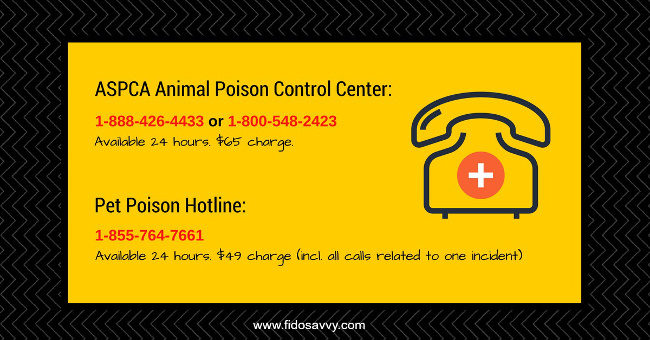
If the charges sounds a bit steep, think how much your dog's life is worth to you, and it will suddenly sound a lot LESS expensive!
you might also like...



FTC Disclosure: Some pages on this site contain affiliate links. I may earn on qualified purchases.
FTC Disclosure: Some pages on this site contain affiliate links. I may earn on qualified purchases.
For your peace of mind, puppy and dog health information on this site has been approved by veterinarian Dr. Megan Teiber, DVM


Tired of Dog Hair everywhere?

These pet hair removing tools have saved my sanity! You can remove dog hair from carpets, rugs, furniture and more SO EASILY. If you think your rugs are fur-free... run one of these babies over them AFTER you've vacuumed. You will me amazed at how much hair was still there.
There's even a deshedding tool to use on your dog before he deposits his fur all over the house. Win-win.