FYI: If you buy something through a link on this site I may earn a commission - at NO extra cost to you.
Puppy Weight Chart
No single puppy weight chart can tell you how big your puppy may be as an adult because there are so many variables. Like human children, puppy siblings will always be different in size, temperament, growth-rate etc.
The charts on this page show ESTIMATED weights for puppies of certain breed sizes at certain ages and are guidelines only.
A healthy purebred puppy will generally grow at a fairly predictable rate based on his breed size, and as an adult will generally fall within a certain range of weight and height.
However, mixed breed puppies are very unpredictable in terms of their growth and eventual size and although there are all sorts of ways to estimate how much your pup might weigh when he's full grown it's not an exact science and many a mixed breed pup has turned out to be exactly what their owner DIDN'T expect!
There are four puppy weight chart samples on this page, one for each size category:
If your pup is a mixed breed you may be able to estimate where he might fit in those categories if you know what size/breed/breed-mix his parents were, but it's still a guessing game and often simply a matter of waiting to see how big he is once he's finished growing!
Genetics plays the most important role in deciding how big your little Fido will be as an adult, but diet, healthcare and even exercise also play their parts.
Every puppy is a unique individual and no two puppies (even from the same litter) will grow at exactly the same rate, or end up exactly the same size.
Using online puppy weight calculators... beware
Interactive puppy-to-adult weight calculators can only estimate your puppy's adult weight if your little Fido is a purebred puppy and the calculator allows you to add this info.
They are wildly inaccurate for mixed breeds because there are so many variables involved, using the hands-on tips and tricks on my Puppy Weight Estimates page is likely to get you closer to the truth :)
Toy Breed Puppy Growth
A dog in this category is likely to reach 12lbs or less (sometimes much less) as an adult. These are the very tiniest dogs of all. Some examples of toy breeds include the Chihuahua, Yorkshire Terrier, Havanese and Pomeranian.
Tiny, miniature and toy breed puppies experience their most rapid puppy growth rate between birth and 11 weeks of age.
They can gain up to 10% of their body weight each week
The smaller the breed, the faster they reach maturity, and in this category many puppies' growth will slow down around eight or nine months. Some may be full grown by this point, others may take a few months longer but all will reach their adult size by one year.
Toy Breed Puppy Weight Chart
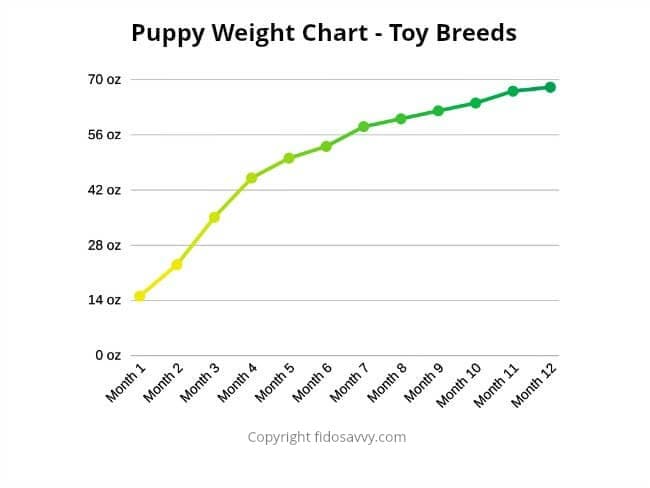
Chart © MyWay LLC Unauthorized duplication or publication prohibited.
The above chart measure weight in ounces. For countries that use the Metric system and want weight in grams and kilograms, this might help:
1 oz = just under 28.5 g
1 lb = .45 kg
Or you can click here to jump to a handy grams to ounces converter tool.
Small Breed Puppy Growth
Small breed puppies are still little dogs, and generally don't exceed 25 lbs as adults.
This group includes popular breeds such as the Miniature Poodle, Dachshund, Boston Terrier, Shetland Sheepdog, Italian Greyhound and the Toy Spaniel.
Small dogs still grow and mature much faster than their bigger counterparts, but not quite as rapidly as the teeny-tiny-toy breeds.
Small breed puppies can gain roughly 5oz per week after they reaches 6 weeks of age, but it's not a smooth growth curve.
Puppies in this category are usually fully grown by ten to twelve months.
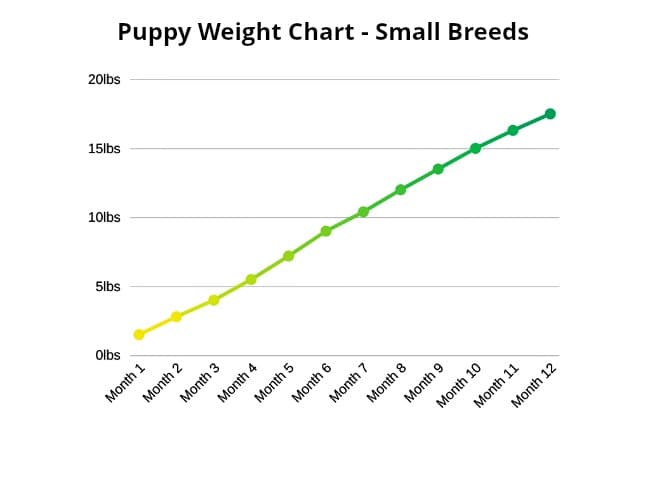
Chart © MyWay LLC Unauthorized duplication or publication prohibited.
On puppy weight charts for small, medium, large and giant breeds, weight is measured in pounds.
If you want to convert pounds to kg's you can use this simple tool Pounds-to-Kilograms conversion. These might also help:
1 oz = just under 28.5 g
1 lb = .45 kg
10 lbs = just over 4.5 kg
100 lbs = 45.3 kg
Medium Breed Puppy Growth
Medium sized dogs usually weigh between 25 and 50 lbs as adults. There are a whole host of breeds in this category, including the Corgi, Australian Cattle Dog, Miniature Australian Shepherd, Border Collie, Whippet and many Spaniels.
Many mixed breed puppies who have more than two breeds in the bloodline fall into this size category as well.
Most medium sized dog breeds are fully grown one year old. At six months some medium breed pups will be approx. two-thirds of their adult weight, but again all puppies grow at different rates so as long as your puppy is healthy and your veterinarian doesn't see a problem with his size/development don't worry if little Fido doesn't fit these calculations.
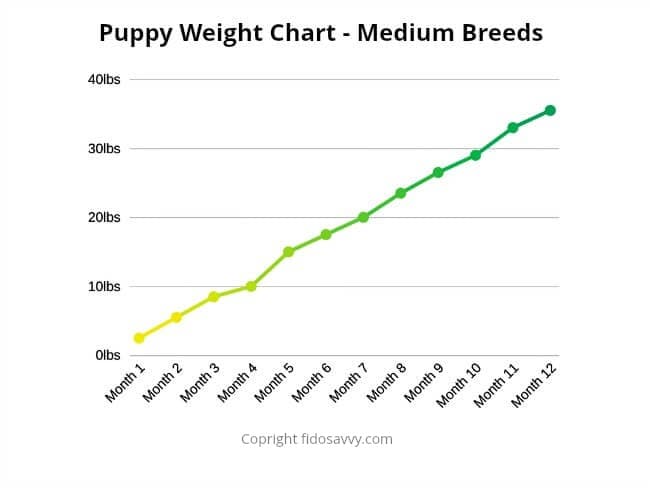
Chart © MyWay LLC Unauthorized duplication or publication prohibited.
Large Breed Puppy Growth
Large breed puppies grow much faster than their smaller cousins.
Large breeds usually top out at around 100 lbs, or a little less, and include the Labrador Retriever, German Shepherd, Weimeraner, Boxer and Doberman Pinscher.
The most rapid puppy growth rate for large breeds takes place between birth and about 5 months of age. Depending on the breed, they may reach maturity/adulthood around eighteen months of age.
By nine months your puppy may weigh half of his eventual adult weight. This rapid growth can cause bone and joint problems and large and giant breed puppies have specific nutrition requirements, this page has tons of info. on raising these big guys... Extra Large Breed Dogs.
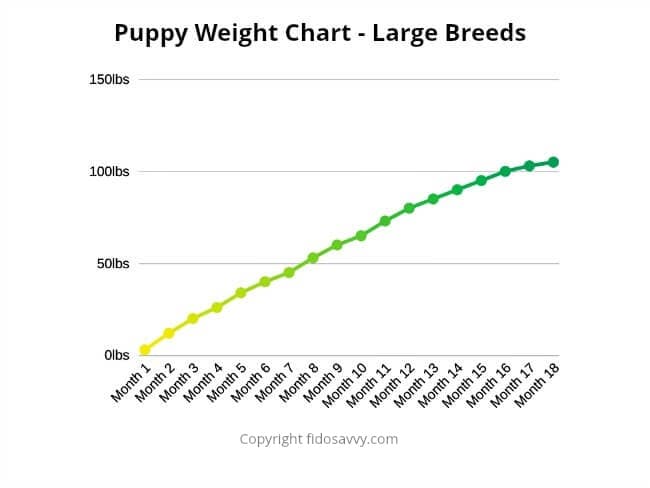
Chart © MyWay LLC Unauthorized duplication or publication prohibited.
Giant Breed Puppy Growth
Giant breed puppies grow so fast it's almost unbelievable sometimes.
One day your puppy is knee high, next day he's about thigh-level... or so it seems anyway. Head, paws, tail... they all seem to grow overnight!
Giant breeds usually weigh well over 100 lbs as adults, and it can be much more for the very largest members of this category, for example an adult Great Dane may weigh 175lbs, and adult Mastiff could be 200lbs, or occasionally more.
Some other breeds in this Giant category include the Saint Bernard, Newfoundland and Scottish Deerhound.
The growth curve for these huge puppies is steep, and it can take eighteen months or twenty four months for them to be fully grown.
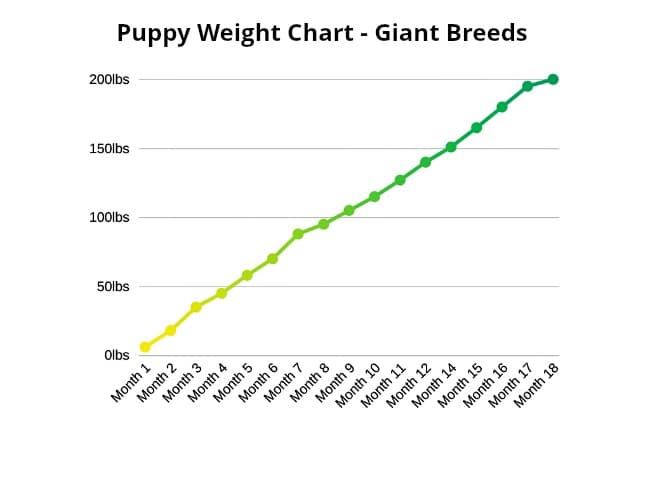
Chart © MyWay LLC Unauthorized duplication or publication prohibited.
Newborn Puppy Weights
Just as there is a significant difference in weight between the larger, and smaller, dog breeds in adulthood, there's also a big difference between the newborn weight of puppies from different breed sizes.
Newborn toy breed puppies could weigh as little as 2.6 oz (7g) while newborn puppies from a giant breed dog could weight in at up to 28oz (800g).
Newborn puppies of medium sized breeds fall somewhere in between, averaging somewhere around 8.8oz (250g)
Puppy Growth
No matter what breed your puppy is, he's going to reach his full height quite a while before he reaches his full weight.

For example, by the time he's four months old your pup may have reached 60% of his adult height, but only 30% of his adult weight.
At six months most puppies have reached approx. 75% of their adult height.
This explains the lanky, scrawny, awkward, and 'out of proportion' look of most adolescent puppies!
Once the growth-plates have closed your pup will not grow any taller. This usually happens when your puppy is somewhere between twelve and eighteen months of age (depending on breed size, the larger the breed the later the plates will be fully fused).
How to measure your dog's height
Measuring the height of your puppy or dog is simple (as long as you can get Fido to stay reasonably still) but what's important is WHERE you measure him.
A dog's height is measured from the top of his shoulder to the ground.
Puppies gain weight at their own pace, and for the first six weeks or so it can vary significantly. After that you can often get in the ball-park.
If you're wondering approximately how much weight your puppy should gain per week, and you know whether he's a small/medium/large/giant breed then these figures are a good rule of thumb:
- Tiny and toy breed puppies - approx. 5 oz per week
- Small breed puppies - approx. 10 oz per week
- Medium breed puppies - approx. 1 to 1.5 lbs per week
- Large breed puppies - approx. 2.0 lbs per week
- Giant breed puppies - approx. 3 - 5lbs per week
'Normal' or 'Average' puppy weight gain
Sometimes pure-bred
puppy owners seem to get too focused on how well their puppy matches up
to the 'normal' growth pattern or weight of the breed.
This can only lead to frustration, because NO puppy will be a perfect match to a chart that shows averages. They're purely there as examples.
Every single puppy will grow/develop at their own rate and there are natural differences in size between dogs of the same breed.
Never be tempted to overfeed your puppy in order to make him grow faster or bigger! That can actually cause damage to bones and joints and a fat puppy is not what you want.
So, please don't become fixated on the weight/height of your puppy.
His overall health and happiness are much more important!
Overweight Dogs & Obesity
Although most puppy owners worry about whether or not their little one is growing fast enough, or big enough, as the pup matures into an adult there is the flip-side of that concern - whether or not their dog is too heavy!
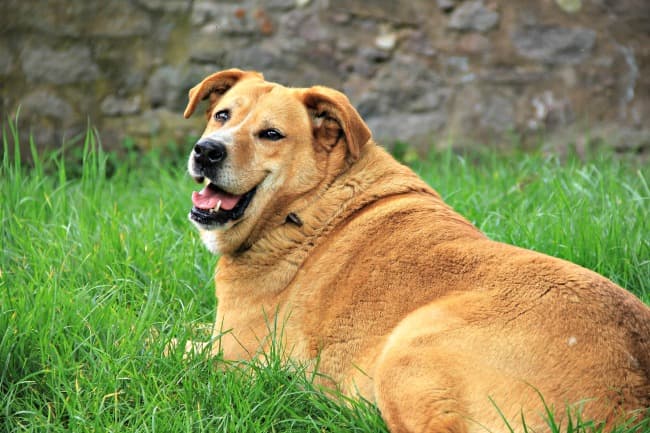
A dog who is overweight, or obese, has a lot of the same health risks that overweight people suffer from.
These include
- Heart Disease
- Arthritis
- Diabetes
- Kidney Problems
- Shortened Lifespan
What dog food you choose, and how much (and how often) you feed your pet, plus of course how much exercise he gets, all play an important part in keeping him trim and healthy.
Puppy weight charts are a helpful tool, but there are so many variables that they can only give you a ball-park idea of little Fido's adult size... and that's only if he's purebred, or very close to it.
In addition you can also learn more about how to get an idea of his adult weight by checking out my Puppy Weight Estimates page (see 'YOU MIGHT ALSO LIKE' section below).
you might also like...



FTC Disclosure: Some pages on this site contain affiliate links. I may earn on qualified purchases.
For your peace of mind, puppy and dog health information on this site has been approved by veterinarian Dr. Megan Teiber, DVM


Tired of Dog Hair everywhere?

These pet hair removing tools have saved my sanity! You can remove dog hair from carpets, rugs, furniture and more SO EASILY. If you think your rugs are fur-free... run one of these babies over them AFTER you've vacuumed. You will me amazed at how much hair was still there.
There's even a deshedding tool to use on your dog before he deposits his fur all over the house. Win-win.