FYI: If you buy something through a link on this site I may earn a commission - at NO extra cost to you.
Separation Anxiety In Your Dog
Separation anxiety in your dog causes acute nervous distress.
It's triggered when your dog is separated from you... and can make Fido (and you) absolutely miserable.
Some puppies and dogs
are just a bit anxious by nature - they might get scared during
thunderstorms, be a little wary around strangers or unsettled by change.
This
isn't terribly unusual and if your pet spends his time playing/napping
while you're out, then he's probably just fine overall.
BUT if
you own a dog who howls, whines, whimpers or barks whenever you're out
of his sight, or not at home, then he's definitely letting you know that
he's upset - but that doesn't necessarily mean that he has true
separation anxiety.
Does your dog consistently act this way when you're gone?.....
- Pace, run in circles or seem to need to be in constant motion?
- Whine, cry, howl, bark incessantly?
- Pant or drool constantly, possibly even vomiting or retching?
- 'Pee' or 'poop' all over the house, or in his crate, even though he's just 'done his business'?
- Chew, scratch, dig, tear up and generally destroy your home?
, to one or more of these questions, then yes it's possible that your dog truly is experiencing some separation anxiety.
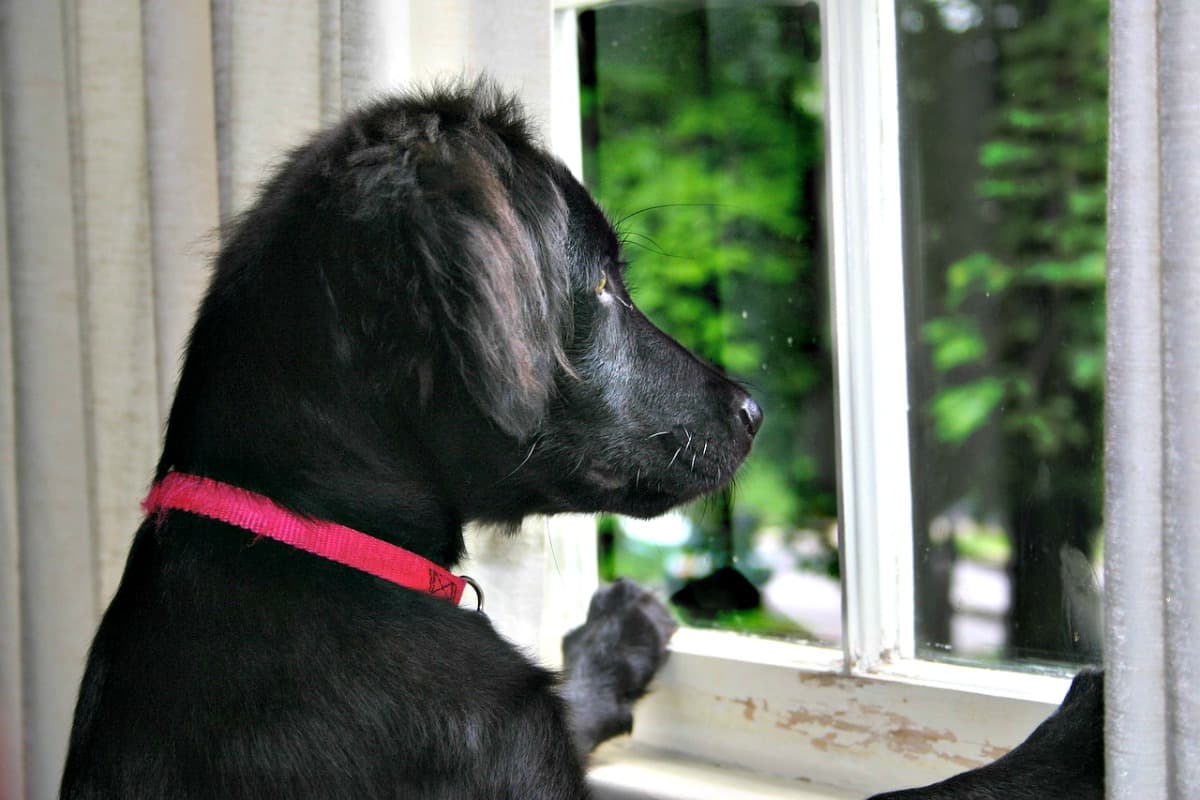 Anxious dog looking out of window
But don't panic (Fido's already panicking, we don't need you to join him!), help is most definitely at hand.
I've put together a straightforward guide to recognizing and dealing with your pet's 'issues', so life for you and your anxious little furchild is about to get a whole lot easier!
My Dog Gets So Upset!
Dogs are very social creatures, and are by nature pack animals.
When left alone, their natural instinct is to 'find' the rest of their pack (that's YOU), and Fido can get very agitated, restless, nervous or even panicked if he isn't able to do just that.
It's natural for a puppy to be upset, scared or worried during the first few days/weeks after you bring him home. This can lead to some mild puppy separation anxiety, and this is perfectly normal.
Separation anxiety in adult dogs is easier to prevent than it is to treat, and there are certain things you can do to help head off potential problems while your pup is still young. As with any habit or behavior, the longer your dog has had it, the longer it will take for him to overcome it.
Sadly, many, many dogs are euthanized or abandoned every year due to the destructive behavior and difficulties associated with dog separation anxiety. But that should never happen because you can help your pet overcome his fears with a bit of help, plus love, patience and time.
A study in the Applied Animal Behavior Sciences journal, found that around 14% of dogs seen by veterinarians for routine care, show some signs of separation anxiety.
This increases to a whopping 40% when you look at dogs who are being treated for behavioral problems.
True separation anxiety in your dog usually produces moderate or severe behavioral issues and your pup will be panicked, or even 'hysterical'.
Mild nervousness, upset or 'complaining' that settles down after some time alone is more likely to be a result of boredom or loneliness. It's just your dog letting you know he doesn't appreciate you leaving him at home!
Understanding how strongly Fido feels about being left alone will play a big role in how you treat his worries, and what steps you need to take to get him past his fears.
Signs Of Dog Separation Anxiety in Your Dog
If your pet is naturally a bit nervous, it can be tricky to tell whether or not his problem is severe enough to need help. Here are some behaviors that might signal mean he has some separation anxiety issues......
While You're At Home:
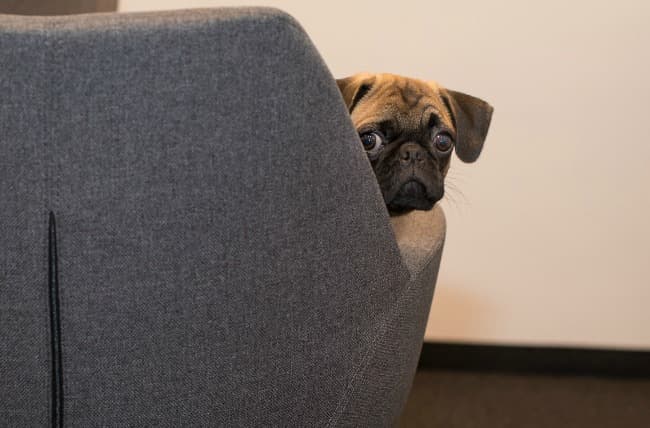
If a dog is truly suffering from separation anxiety, he will usually show at least some of these signs in his everyday behavior.
- Velcro-dog syndrome. If he is constantly clinging to you, following you around and 'glued' to your side
- He demands attention on a continuous basis. Pawing, barking or nudging you all the time
- He gets very upset if you're out of his sight, and can't be left in another room by himself without getting agitated
- He becomes nervous and agitated when he sees you getting ready to go out (for example when you pick up your car keys, put on your coat etc.)
- You see a significant change in your pups' behavior, such as an increase in aggression or shyness, which is not 'normal' for him
When You're Out:
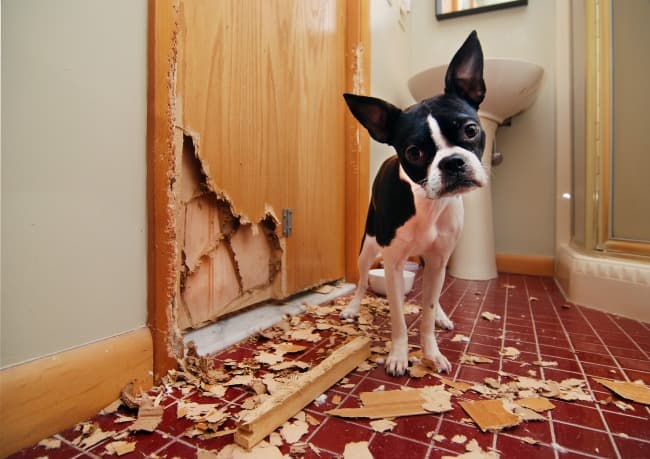
- Barking, whining or howling that is continuous, and lasts the whole time you're out
- A constant state of restlessness, shown by behavior such as pacing, circling, pawing and often accompanied by panting and/or shaking
- Destruction of objects, furniture or even the structure of the
house itself. Chewing is often focused on items that belong to the
person the dog is closest to (such as clothes, shoes, hairbrushes etc.).
Gnawing, chewing and scratching at doors, window frames/screens, flooring etc. is usually due to your dogs' desire to escape and 'find' his pack - 'Peeing' or 'pooping' several times and in several different areas/locations within the house
Treating Separation Anxiety In Your Dog
Although it's not strictly possible to cure a dog of this type of anxiety,there are lots of ways to reduce and even eliminate his distress symptoms... and the problem behaviors it causes.
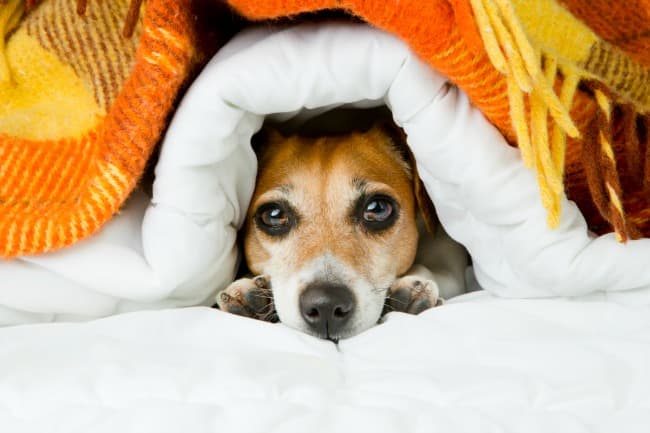
With time, love and patience you can teach your pup that he
needn't be afraid when you leave, and that you are always going to come
back home. Helping Fido feel safe in this knowledge will go a long way towards getting him to feel more relaxed in general.
Behavioral Modification/Training
My Dog Training For Separation Anxiety page explains some tried and true methods to reduce your pups' obsessive dependence and clinginess. These can also help him learn to relax and amuse himself when you're not home.
Background Noise
One tactic that often works very well is to use a dog relaxation cd or dvd to keep your pup calm, relaxed and entertained while you're away.
Studies and research have shown that a certain slow-tempo classical music can reduce anxiety in dogs by 70 - 80%. That's pretty significant!
You can find the best dog relaxation cd's and more on my Dog Relaxation CD page.
Natural Remedies
There are some excellent natural remedies that can help reduce anxiety in dogs (whether it's due to separation, noise anxiety, travel, vet visits or whatever).
Popular anti-anxiety products for dogs include Bach Rescue Remedy for Pets, HomeoPet Anxiety relief and 4Paws Hemp Oil Supplement
Or maybe you want to try dog aromatherapy.
This might sound a little strange, but it works in the same way for dogs as it does for humans.
When you think about how sensitive a dog's nose is and how attuned his is to the scents of the world around him, it's not surprising that aromatherapy can be so effective.
Another scent-related product which is totally safe and very effective against anxiety of all sorts are canine pheromones.
There are a host of pheromone products on the market.
In our family we use them regularly for dogs or puppies who are anxious, stressed or fearful for any number of reasons:
- Adaptil D.A..P. Pheromone collar for small dogs & puppies
- Adaptil D.A.P. Pheromone collar for medium to large dogs
- Sentry Good Behavior Pheromone collar 23"
- Comfort Zone with DAP Pheromone Diffuser
- Comfort Zone DAP Pheromone Spray
Here are a few more safe and natural options that can help ease Fido's anxiety:


You might also like to check out these pages for additional help:
Get Fido A Thundershirt
A Thundershirt looks like a dog coat, but it's actually a scientifically designed, and highly effective, 'wrap' that uses gentle, constant pressure to calm your dog's central nervous system.
This helps him
to relax and to feel safe and secure. It follows the same principle as swaddling a baby.
Recommended by thousands of dog owners, veterinarians and
professional dog trainers, this is one of the simplest ways to relieve
anxiety in dogs of all ages, sizes, breeds and temperaments.
Things That WON'T Help
- Punishing him for his behavior, will only result in an
increase in the problems. He's already anxious enough, if you punish or
scold he'll be even more upset and afraid. Your dog needs love, understanding and patience if he's to overcome his fears.
- Adding another pet to your household. Your dog's fears will also generally not be helped by bringing in a new family member.
Although to a human it makes sense that he may feel less alone and
upset if he has a friend, to your dog it's not as straightforward as that.
Bringing a new dog or cat into the home is more likely to make him anxious and possibly jealous. Although most dogs adjust to the new member of the household eventually, in the short term you will only be increasing his anxiety and unhappiness. - Crate training
may or may not make the situation worse. If your dog is destroying your
home and possessions while you're gone, a crate is the best, most
logical solution.
However, if he's an adult dog who has never been crate trained he may not be happy about this at first.
If you do have to introduce the crate as a new tool, do it as gradually as possible and get him used to it with you at home. Don't just put him in the crate for the first time and leave...he'll associate the crate with his anxiety and reinforce the problems.
you might also like...



FTC Disclosure: Some pages on this site contain affiliate links. I may earn on qualified purchases.
FTC Disclosure: Some pages on this site contain affiliate links. I may earn on qualified purchases.
For your peace of mind, puppy and dog health information on this site has been approved by veterinarian Dr. Megan Teiber, DVM


Tired of Dog Hair everywhere?

These pet hair removing tools have saved my sanity! You can remove dog hair from carpets, rugs, furniture and more SO EASILY. If you think your rugs are fur-free... run one of these babies over them AFTER you've vacuumed. You will me amazed at how much hair was still there.
There's even a deshedding tool to use on your dog before he deposits his fur all over the house. Win-win.